21
Oct
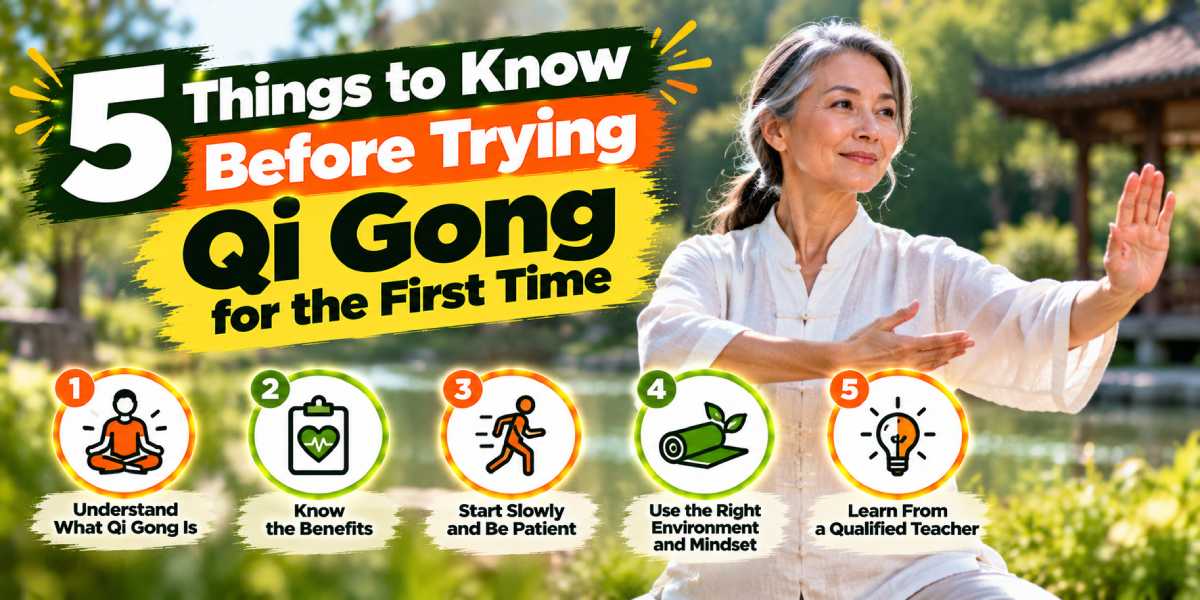
5 Things to Know Before Trying Qi Gong for the First Time
Have you ever seen anyone doing Qi Gong in a park? Slow movements with controlled breathing may have confused you about whether it is exercise, meditation or something else. It could well be possible that it can be all of these. Qi Gong is an ancient Chinese mind-body practice involving movement, breathing, body positioning, and concentration. For those who have never tried it before, you should be able to see this practice as a good way of getting out of difficult exercise since you won’t need to join a gym or use any equipment at all.
But before you unroll your yoga mat and start watching your very first tutorial video, there are certain things that you need to learn. There are five things that you need to know before your first class.
1. Qi Gong Is Gentler Than It Looks—But It Is Still Practice
The most common myth associated with Qi Gong is the assumption that since the movements are slow, it must be an exercise that is easy or not worth paying much attention to. On the contrary, the slowness of the exercise is its main feature and allows us to pay attention to all those things that we normally cannot observe when training in a fast manner – how our shoulders lift during the breathing process, how our weight is distributed, how we carry tension, etc.
When practising Qi Gong, one is supposed to coordinate his/her movements with breathing and at the same time stay mentally involved in the process. All of this seems quite simple until one realises that it is not always that easy to do so – the mind keeps wandering away, the body is stiff, and we feel awkward doing exercises which seem to be effortless when done by someone else. However, none of this indicates that we do something wrong.
Consider it not as a workout that we have to do but as a kind of conversation with our body, sometimes easy, sometimes not.
For beginners, this is good news. You do not need to be athletic, flexible, or experienced in meditation. You simply need a little space, comfortable clothing, and a willingness to slow down.
2. It May Help With Stress, Balance, and Pain—But It Is Not a Miracle Cure
Qi Gong has been investigated for various health conditions, and the outcomes have been encouraging in some and still under investigation in other aspects. For instance, Qi Gong may be beneficial in improving the condition of certain patients suffering from pain, stiffness, and physical function, especially concerning older patients and those with musculoskeletal pain. Regarding the use of Qi Gong in treating chronic neck and low-back pain, the results are inconclusive; hence, it is always wise to set realistic expectations.
Improvement in this regard will not consist of changes in your pain symptoms, but rather changes in your mood. Slow breaths will help calm down your nervous system. Soft movements will help relax the “rigidity” of your muscles that have been strained by being at your desk for quite a while. Finally, Qi Gong may offer you a possibility of psychologically getting out of an intense morning session and moving on into your daily affairs.
Still, Qi Gong is not an alternative to the necessary medical care and treatment of a particular condition. Instead, it should be treated as a complementary practice—Qi Gong is an important part of a more complex approach to health. If you suffer from persistent pain, an injury, vertigo, heart/lung disorders, problems associated with your pregnancy, or have had any kind of surgery recently, consult with your doctor before practising Qi Gong.
This is precisely what PainBegone does. Their Qi Gong-based programs for pain management provide for the maintenance of balance, mobility, concentration, and general well-being, which goes along with Qi Gong exercises.
3. Your First Sessions Should Be Short, Simple, and Comfortable
Often, when people start a new wellness exercise, they tend to do too much at once. In the case of Qi Gong, such an attitude usually leads to failure. Patience pays in this practice. Ten or fifteen minutes of work can bring more results than an hour of distracted and hard effort.
For the first time when you practice, find a quiet place where you will not be disturbed by anybody. Dress in clothes that are comfortable for you. Also, you may practice being barefoot. It is desirable to position your feet at hip distance and slightly bend your knees. Relaxation of the shoulders is also important. If it is difficult for you to practice in a standing position, some exercises of Qi Gong can be performed while sitting.
Perform simple movements rather than the complicated sets. Just rotations of the arms, shifts of weight, exercises for shoulders, and breathing deeply will be enough for warm-up. You should not control your breathing — it must be natural. In case of any unnatural breathing or holding of breath, substitute it with some other exercise.
It is quite beneficial to end your exercise with a few minutes of immobility. Just hang your hands down and, if possible, close your eyes. Pay attention to your breathing.
4. A Qualified Instructor Can Save You Months of Guesswork
You definitely can start your practice by using beginner-level videos, but working under the guidance of an instructor might really make a difference, especially if you do Qi Gong due to your pain, stiffness, stress, and restricted movement. Your instructor is capable of identifying your bad habits which you don’t even realise you have: locked knees, shallow breathing, jaw clenching, uneven distribution of your weight, and movements which exceed your range of motion.
Good coaching does not mean that your instructor will push you further. It means that he will coach you to move in the right way.
This is where PainBegone’s approach can be especially useful. The service offers guided Qi Gong practices alongside holistic wellness support, with training in Qi Gong, hypnosis, and natural health practices. For someone new to the practice, that kind of guidance can turn vague instructions into something concrete: how to breathe, where to place your attention, when to slow down, and how to adapt movements safely.
Before choosing any instructor or program, ask a few simple questions. Do they explain modifications? Are they comfortable working with beginners? Do they encourage you to stop or adjust if something hurts? A trustworthy teacher will welcome those questions rather than make you feel as though you should already know the answers.
5. Consistency Matters More Than Intensity
The most common beginner’s error is to believe that one can get much benefit from the first attempt. The matter is that Qi Gong cannot be considered an individual treatment. It is a practice that becomes more effective with frequent use. Just as you cannot hope that one healthy meal will improve your diet, you cannot hope that one Qi Gong session will eliminate stress, bad posture, or chronic tension formed over the years.
It is better to try to practice little but often. Five minutes in the morning will give a different mood for the whole day. Ten minutes after work will help to relax. Even five minutes of mindful breathing and doing gentle shoulder exercises when it is busy at work will make a difference.
There is some research devoted to Qi Gong influence on fibromyalgia. In some of them, the participants who exercised diligently (for about half an hour daily for six to eight weeks) had improvements in pain, sleep, physical and psychological well-being. Of course, you do not have to start with this time of practice.
Try attaching your practice to something you already do. After brushing your teeth, before your first meeting, or immediately after changing out of work clothes are all simple anchors. The easier it is to begin, the more likely you are to continue.
How to Make Your First Experience Enjoyable
Your first Qi Gong session does not need to be remarkable at all. In fact, it must not be. Choose one sequence only, keep it brief, and focus on what you feel after the practice instead of how well you performed during it.
To feel more relaxed, more centred, or simply more aware of your breath means that you are successful. To feel tense and distracted means that you are performing successfully too. The practice is not about achieving a state of mind, but about returning to the body over and over, yet always with inquiry.
It is especially important for those who suffer from pain and stress. Pain makes movement a scary thing. Qi Gong provides an opportunity to reconnect with movement in a gentle way, without pushing the body to do things it is not ready to do yet. PainBegone’s programs include all these aspects of Qi Gong.
Conclusion
Qi Gong is the best choice for the realm of mindfulness for people who find exercises too difficult or hard. To perform Qi Gong exercises, one would require several minutes of time, privacy, comfortable clothes, and the ability to breathe deeply and move one’s body gently.
Nevertheless, there are certain measures that need to be considered before starting the practice. Firstly, one should start slowly. Do not have unattainable expectations from Qi Gong practice. Learn how to do Qi Gong properly with a good instructor and adjust the movements to your body. Above all, be consistent.
With patience, time, and regular practice, Qi Gong might become not only another passing fashion but also a great way to stop, move mindfully, and take care of your body and soul. For any assistance with Qi Gong and holistic health practice services that will help you reduce stress and improve your movement and energy, please visit PainBegone.