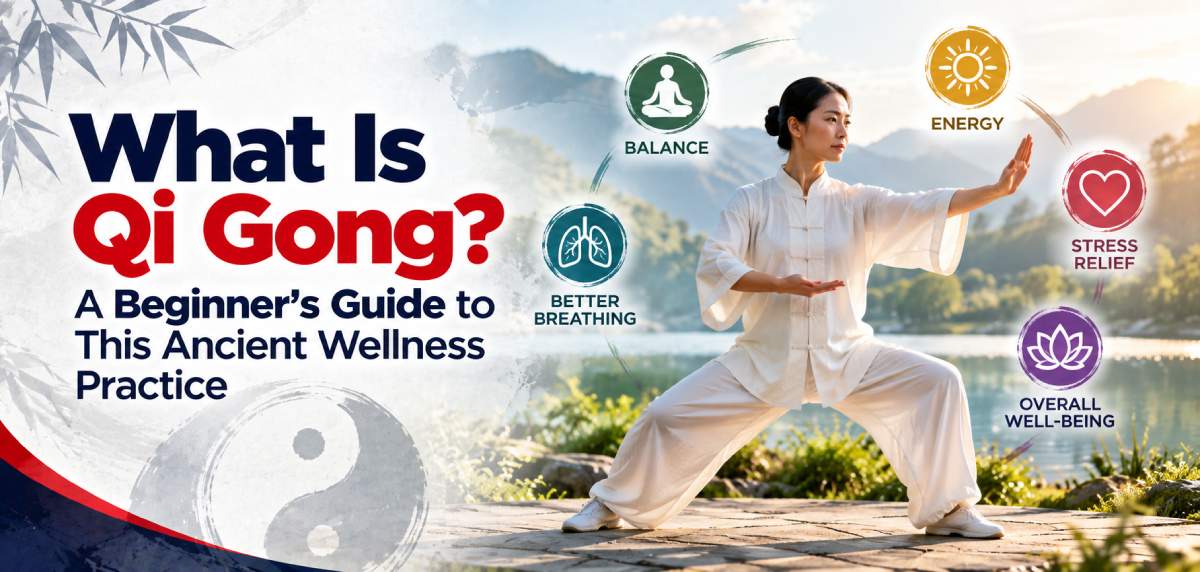
What Is Qi Gong? A Beginner’s Guide to This Ancient Wellness Practice
When you feel mentally exhausted after Zoom meetings, physically tense due to sitting all day, and overall disconnected from your physical self, it is not unusual. With today’s fast-paced, hyperconnected society, an age-old practice called Qi Gong, which translates as “Qi” work (“chee-gong”), can serve as a much-needed respite. The art of Qi Gong is a product of millennia of Traditional Chinese Medicine and consists of the gentle exercise, breathing techniques, and focused meditation aimed at balancing the energy, or “qi,” within the body. As a tech professional looking for opportunities to optimize processes and systems, Qi Gong provides an intriguing way of optimizing yourself.
Understanding Qi Gong: More Than Just Movement
Qi Gong is a practice that aims at increasing the flow of energy in one’s body. This term can be separated into two distinct words: “qi,” meaning vital energy or life force, and “gong,” which means skill achieved by practice. Contrary to vigorous workouts, the practice of Qi Gong focuses on very slow and deliberate moves with deep rhythmic breaths and intention.
Qi Gong can be seen as a moving meditation practice. Though yoga or tai chi also involve breathing and moving, Qi Gong usually has a simpler structure and easier to start with as a beginner. Some Qi Gong exercises are rather easy to master within minutes and can be performed literally everywhere, from one’s home office or quiet area of one’s co-working place to taking a small break between coding sessions. Qi Gong affects various aspects of your life positively, both physically by helping you improve your balance and flexibility and mentally by decreasing stress and increasing your concentration.
A Glimpse into Qi Gong’s Rich History
The history of Qi Gong dates back more than 4,000 years, which makes it one of the oldest living traditions for health maintenance in humans. It has its deep historical connection with Daoism, Confucian and Buddhist philosophy, and the classical Chinese medicine based on Huangdi Neijing. Many of the principles of Qi Gong practice were developed by the legendary Yellow Emperor, who lived between 2696 and 2596 BCE.
Over thousands of years, Qi Gong has developed through several streams. Daoists practised it as a path to immortality and enlightenment, while Confucians used it to cultivate moral and mental qualities. Martial artists also practised it to enhance their physical abilities and combat skills.
As time passed by, all these different streams formed the Qi Gong tradition known to us nowadays.
Although Qi Gong boasts an ancient tradition, it has come back into the limelight due to the increasing acceptance by scientists that there are many health benefits to be garnered from it. There are scientific studies proving that practitioners of Qi Gong exhibit better cardiovascular functions, increased immune responses, reduced pain levels, and improved psychological state. It is therefore easy to see why many analytical minds prefer Qi Gong.
The Three Main Categories of Qi Gong Practice
Qi Gong encompasses a wide variety of styles and forms, but they generally fall into three primary categories, each serving distinct purposes.
Healing Qi Gong pertains to the practice of healing and maintaining good health. This type is more useful for people who are seeking for wellness and it encompasses the self-healing, wherein the person performs certain movements that can help him or her achieve his or her good health and avoid illnesses, and the external Qi Gong (or Qi emission), where the practitioner uses the energy to heal other people. Healing Qi Gong serves as the energy basis for Traditional Chinese Medicine, which predates and inspires practices such as acupuncture, herbs, and massage.
Combat Qi Gong focuses on gaining strength, endurance, and fighting abilities for the person involved. Combat Qi Gong is practiced by individuals practicing Chinese martial arts like Kung Fu and Tai Chi to improve their fighting ability.
Spiritual Qi Gong seeks enlightenment, realisation, and deep meditative states. It is based on the traditions of Daoism and Buddhism, with an emphasis on inner practices, consciousness enlargement, and universal energy. The practitioners of Spiritual Qi Gong usually try to go through deep meditation to attain advanced states of peacefulness and enlightenment.
For those who are beginning their practice, particularly for people who want to reduce stress, Medical Qi Gong can be the easiest way to enter into it.
Why Qi Gong Resonates with Tech Professionals
For people who work in the technology sector, the job is different. Extended periods of sitting and staring at a computer screen, the constant switching from one task to another, and having to be productive all the time, have an impact on your health. And here is how Qi Gong can help you with it.
According to scientific studies, regular practice of Qi Gong reduces stress, anxiety, and depression. Qi Gong stimulates the parasympathetic nervous system, which may help people manage the chronic stress often associated with knowledge-based jobs. Research has also reported potential physical health benefits alongside these psychological effects. Namely, balance, immunity, sleep quality, as well as cognitive functions, including memory, spatial cognition, and information processing.
Moreover, Qi Gong requires minimal time investment. Even just 10 to 15 minutes a day can yield noticeable improvements in energy levels and overall well-being. This makes it an ideal practice for busy professionals who might struggle to commit to longer workout routines or meditation sessions.
Getting Started: Simple Principles for Beginners
What makes Qi Gong really intriguing is the accessibility of the practice. It does not require you any special equipment, gym membership, or previous experience. Let’s consider some basic principles that will help you start:
Proper Posture: A correct posture is important for Qi Gong practice. Stand with your feet shoulder-width apart, keep knees slightly bent, spine stretched, and shoulders relaxed. Feel like a string is pulling the top of your head upwards while keeping your feet on the ground. This position enables the free flow of energy in your body.
Breathing: Qi Gong practices deep abdominal breathing. Inhale slowly through your nose, allowing your abdomen to fill up with air, then exhale gently without exerting any extra effort. Coordinate your breathing with your movements to facilitate the qi flow.
Movements: In Qi Gong, all movements are performed slow, smooth, and deliberate. There is no hurry here. Focus on the quality of movement, not on the quantity. Basic exercises that beginners can perform include such ones as “Lifting the Sky”, in which you lift your arms above your head during inhalation, and “Holding the Ball”, when you keep an invisible ball in front of your body.
Consistency Over Intensity: Like any skill, Qi Gong benefits from regular practice. Aim for short daily sessions rather than occasional long ones. Even six minutes a day can make a difference over time.
Integrating Qi Gong into Your Daily Routine
When it comes to tech savvy people who love to hack their productivity and optimize their processes, integrating Qi Gong into their lives may be approached the same way. Think of doing Qi Gong as an essential step of your daily routine – just like reading and replying to emails and participating in the morning stand-ups.
There are many cases when practitioners manage to successfully integrate Qi Gong into their lives by combining it with the existing routine activities. For example, some do Qi Gong in the beginning of the day in order to create a proper mood for the following activities. Others prefer doing Qi Gong during the day, as a way to recharge in between long and tedious working hours. Some practice Qi Gong at night, in order to have better sleep.
Firstly, there is a rule of starting small and going step by step. This implies starting with the exercises of one or two types and adding new ones progressively.
Having a special place for your practice will also help you to get better results. Of course, you don’t have to have an entire meditation room. Even a small corner of your home will do well as long as it allows you to stay or move around quietly. Many people prefer to decorate their practice space with some light, plants, or even music.
How PainBegone Supports Your Qi Gong Journey
Although Qi Gong is a practice that anyone can do, having a qualified instructor will speed up the process of becoming an efficient practitioner and prevent any harm from happening. This is what makes PainBegone’s unique knowledge very useful for you. Being a holistic wellness center, PainBegone provides not only Qi Gong classes, but also other integrative techniques to manage your pain and increase vitality.
PainBegone’s services are well suited to people who need personalised care. Its instructors have training in Qi Gong and 21 other holistic techniques, allowing them to recommend an approach tailored to each person’s needs, whether they experience pain, low energy, insomnia, or stress.
Instead of providing generalized help, PainBegone treats the whole individual—body, soul and mind.
For tech people who believe in using data-based and outcome-oriented processes, the approach taken by PainBegone can be quite appealing due to its combination of ancient knowledge and modern wellness science. It uses a series of techniques to increase energy, enhance flexibility, mood, and sleep, which do not involve taking any medications and undergoing excessive physical activities. If you wish to begin or refine your practice of Qi Gong, PainBegone offers you everything required to make it successful.
The most remarkable feature of PainBegone lies in its holistic approach. The thing is that it understands that wellness is not only about the correct performance of various exercises. Instead, it requires the detection of the problem, formation of sustainable routines and the creation of favorable conditions for them to succeed. This is why PainBegone experts provide customized solutions that involve not only Qi Gong but also some other techniques.
Embracing a Balanced Digital Life
Uniting through technologies but dividing in our souls, Qi Gong is what we need to return to nature. This approach takes into account not only traditions but also the modernity, uniting ancient knowledge and the needs of the present times. If you happen to live in a technologically developed world, Qi Gong is not an escape from technologies; it is their supplement in the process that allows you to grow physically, mentally, and spiritually.
Spending just a few minutes per day in the process of exercising and breath control, you can reinforce your bond with yourself, bring your mind into a peaceful state, and reach an unlimited energy source. Nevertheless, thanks to the help of professionals, such as those from PainBegone, you will have the opportunity to develop the principles of Qi Gong according to your needs.
Final Thoughts
Qi Gong is not just an exercise but a way of life that develops throughout one’s existence. Whether you want to ease physical or mental stress or simply feel more in tune with yourself, this ancient wellness system can help you achieve greater balance and well-being. Take it slowly, but steadily and see how powerful it is to develop one’s qi.