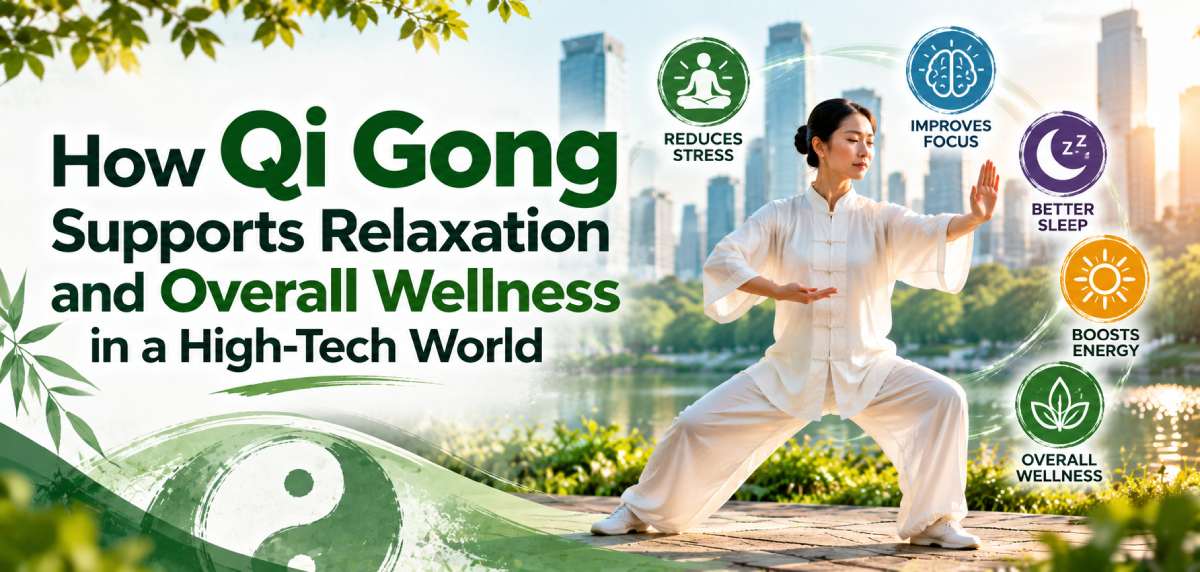
How Qi Gong Supports Relaxation and Overall Wellness in a High-Tech World
Modern times operate at incredible speeds. Notifications can arrive before breakfast, while people plan their weeks in advance and stay connected to work throughout the day. Computers, smartphones, and smartwatches make it possible to work from almost anywhere, from the office to the sofa. The technology makes communication, work productivity, and information exchange easy and fast, but at the same time, it makes it difficult to disconnect from it all.
Nowadays, people find themselves stressed not only at work but also with tense muscles while having video conferences, with headaches caused by too much time spent in front of the computer, with insomnia and tiredness, with shallow breathing, and the feeling that their minds never rest. And that is where Qi Gong can offer something incredibly easy and simple.
PainBegone recognises that achieving overall wellness is not just about managing pain once it starts. It involves establishing practices that allow the mind and body to heal from the rigours of daily life. One such practice is Qi Gong. Due to its integration of movement, breathing, posture, and focus, it may be a viable part of a wellness routine for all ages and abilities.
What Is Qi Gong?
Qi Gong (also known as Qigong) is an old Chinese body and mind exercise involving light physical exercise, breathing techniques, meditation, and concentration. In this regard, Qi can be translated as vital energy or life force, while Gong stands for any kind of acquired skills.
On a more practical note, Qi Gong can be characterised as slow, controlled and mindful movement. It requires you to become aware of your bodily sensations rather than perform rapid repetitions or strive for any performance measurements.
The typical Qi Gong exercise may include standing or sitting positions, stretching, weight transfer, arm circles, twisting the spine, and breathing. In some cases, this routine can be very structured; in others, it can be performed in a small room between meetings.
That flexibility makes Qi Gong especially relevant for today’s tech-savvy audience. You do not need a large gym, expensive equipment, or an hour-long workout window. A few mindful minutes away from a screen can become a valuable reset for both body and mind.
Why Relaxation Feels Harder Than Ever
Relaxation is often misunderstood as doing nothing. In reality, genuine relaxation is an active shift in the body’s stress response. It is the process of moving away from constant alertness and helping the nervous system recognise that it is safe to rest, recover, and restore energy.
Such digital technology may pose difficulties for accomplishing the transition. All the same equipment that allows us to communicate, work, shop, study, and take care of our health makes it hard to concentrate. Thus, moving from one activity to another, we might find ourselves holding tension in the jaw, lifting our shoulders, and taking breaths of air without noticing.
Our organism does not always draw the distinction between a real danger and the never-ending flow of emails, messages, deadlines, and various other reminders. Eventually, all of this may result in physical tension and mental exhaustion.
This is when the practice of Qi Gong becomes useful since, instead of struggling with our mind, we allow the process to be based on the natural abilities of our body. This implies that there is no need for us to clear our minds to enter the state of tranquillity; rather, all we have to do is practice movement, breathing, and concentration to enable us to do so.
Qi Gong serves well for those who have a problem with conventional meditation practices. Trying to sit still with racing thoughts might be frustrating. In Qi Gong, relaxation becomes more attainable through the practice of movement and mindfulness.
How Qi Gong Helps the Body Release Tension
Often, stress shows itself in the body before it becomes emotional stress. It could manifest as a stiff neck at the end of a day at work, as back stiffness from sitting for a prolonged period of time, or even as pain in the hands and forearms from repetitive use of the computer mouse and keyboard.
The movements of Qi Gong tend to be slow, gentle, and are linked to the breathing pattern. This slower pace allows you to focus more closely on muscle tension, posture, and how you perform each movement. The focus is not on speed but on paying attention to what happens in the body. It gives you enough time to notice that your body is tense somewhere and allows you to release it.
An example of a movement would be standing with the feet shoulder-width apart, inhaling and slowly raising the arms, and exhaling while the arms descend. It may seem too simple when you read about it, but once you try it, you notice whether your shoulders are raised or your breathing feels restricted.
That awareness matters. You cannot change a pattern you do not notice.
However, our method recognises that at times the pain felt may not be due to just one reason, but may be due to many reasons such as poor posture, repetition of certain tasks, lack of motion in the joints, stress, insufficient sleep, or even physical inactivity. But Qi Gong should not be used in place of medical intervention when the pain felt is chronic and its origin unknown. Nonetheless, it can become an important part of your overall pain management regimen.
The non-aggressive nature of Qi Gong may make it an attractive option to you if you dislike vigorous physical activity, have returned to physical activity after taking some time off, or just want to find an easier method of becoming body aware.
The Connection Between Breath, Focus, and Calm
Inhalation is the quickest way to affect your state instantly. When a person is under stress, he/she tends to breathe faster and in shallow breaths. As a result, the body starts receiving a signal that it needs to do something fast.
Qi Gong promotes deeper and slower breaths. Breathing often synchronises with movement: inhale as you stretch or lift your body, then exhale as you lower, relax, or centre yourself. This rhythm creates a feedback loop that relaxes the body, slows the breath, and calms the mind.
For people who are working all day long solving different tasks, analysing data, switching from one application to another, and dealing with fast-changing needs, this technique seems to be a good reboot.
It can be compared to closing some unnecessary tabs in your computer. You won’t be able to get rid of all the tasks and responsibilities immediately, but you will be able to create space for yourself to return to work with a clear mind and less tension.
This is one reason the practice fits well into modern routines. You can use it before opening your inbox, after a demanding meeting, during a mid-afternoon energy dip, or as part of a wind-down ritual before bed. It does not require perfect conditions. It only requires a willingness to pause.
Qi Gong and Everyday Wellness
Wellness is not a singular concept but the result of various actions, including exercise, relaxation, stress management, eating habits, social connections, and the response to the body’s feedback. The practice of Qi Gong fosters this holistic approach by promoting consistency instead of intensity.
- If it is done consistently, Qi Gong can have several benefits in our daily lives, including:
- Being more aware of our body posture and movement while spending time in front of screens
- Feeling calmer during times of stress
- Easy flexibility of those body parts which tend to be tight, like the neck, shoulders, hips, and back
- Mindful transition from work to leisure time and then to sleeping
The key word is “regularly.” A five- or ten-minute practice performed most days may be more realistic and beneficial for many people than an ambitious routine that only happens once a month.
People who are interested in technology already know about the benefits of making small inputs continuously. A machine may work well after occasional maintenance, but regular upkeep keeps it functioning at its best. Small moments of movement, breathing, and recovery can add up.
However, unlike software updates, the body does not need optimisation at every moment. It needs compassion, responsiveness, and recovery. Qi Gong can help shift the focus away from constantly measuring performance and toward listening to what the body needs.
A Practical Qi Gong Reset for Screen-Heavy Days
It is not necessary for one to be an expert in order to feel the grounding nature of Qi Gong. One may simply start with a mini exercise from their house, office, or even next to their desk.
Start off by standing up straight with feet hip-width apart. Make sure that the knees remain soft and not locked. Keep both feet grounded on the floor and have the arms hang down by the sides. You need to watch your posture carefully.
Inhale deeply and slowly as you raise the hands in front of you, keeping them at a height where you feel comfortable. Remember that your shoulders should not be tense, and exhale slowly, allowing the built-up tension to dissipate. This should be done five to eight times.
Then, place your hands lightly over your lower abdomen or rest them at your sides. Take several slow breaths. Instead of trying to force deep breathing, allow the breath to become a little smoother and calmer. Notice the contact between your feet and the floor.
End by gently rolling your shoulders back and forth and slowly moving your head from side to side.
This short exercise will probably take you less time than scrolling through a couple of social media sites, but it can make for a more valuable break from your day. This is not about reaching an ideal level of relaxation. This is about breaking that pattern of stress long enough for your body to catch its breath.
How PainBegone Supports Your Wellness Journey
The staff at PainBegone is convinced that knowledge-based care can turn wellness into something more tangible. Whether you are coping with chronic pain, recovering from physical efforts, experiencing stress from work, or looking for ways to improve your flexibility and relaxation, the holistic way of thinking can be very useful for you.
Indeed, Qi Gong practice is one of the things which can help in it as it encourages healthy movements and recovery. However, this is only one small part of the bigger picture. Chronic pain, limited movement, recurrent headaches, numbness, sudden weakness, and other symptoms that affect daily activities deserve careful attention.
That is why our specialists are always ready to provide the person with information about the possible causes of discomfort and offer some ways of overcoming it. In particular, they can give advice on how to move, sit properly, recover, change one’s lifestyle and manage pain.
For people who live and work in highly connected environments, this personalised perspective is valuable. Your health is not an app notification, a step count, or a productivity score. It is an ongoing relationship with your body. Practices like Qi Gong can help strengthen that relationship by creating quiet moments in which you can notice, respond, and care for yourself.
Building a Sustainable Practice
The best way to stay well is by finding what you can stick to. It doesn’t mean that you have to turn your life upside down in one day or spend hours practising each day. Just set yourself a reasonable goal, such as Qi Gong practice for five minutes either after lunchtime or at the end of your computer workday.
It might be useful to relate your practice to something you already do regularly. Practice Qi Gong for a few minutes after having your coffee in the morning, between your last meeting and your dinner time or when your computer loads up. Habit stacking can make new routines feel less like another item on the to-do list.
It can also help to remove the pressure to do it perfectly. Some days, you may have twenty minutes. Other days, you may only have three. Both count. It is not to establish yet another performance goal but rather to provide additional opportunities for stillness, movement, and awareness.
And if you engage in wellness technology, do so mindfully. Your smartwatch or calendar reminder can encourage you to move around for a while, but don’t make that activity another obsession. Let technology support the habit without taking over the experience.
Conclusion
Qi Gong is a perfect response to the stress caused by the fast pace of life in our times, as with its slow movements, breathing techniques, and mindfulness, it can help people achieve relaxation, body awareness, mobility, and balance.
In a world where technology rules and everyone expects immediate results, Qi Gong allows one to take a break without being disconnected from oneself. No special equipment or intense physical activity is required. The process remains simple and natural: move and breathe with conscious intention.
At PainBegone, we believe that wellness requires time and effort. Integrating Qi Gong practices along with the guidance on how to manage pain, increase mobility and recovery is what allows building better habits that will make your body feel great.