How Gentle Movement Can Support Mobility and Wellness
When we live in a world of ubiquitous screens and slowly creeping sedentariness is taking its toll on our bodies, light movements become a sustainable way to increase mobility, reduce pain, and enjoy good health. In a world of people working long hours on computers, coding, designing, and analysing information, mindfully adding light movements becomes a requirement for keeping your body in top form. On average, a knowledge worker sits at a computer for more than six hours per day.
The Hidden Cost of Sedentary Tech Work
Modern workplaces require long hours of sitting and staring into computer screens in the same repetitive postures day by day. This kind of inactive routine leads to tightness in some muscle groups such as the hips, shoulders, and spine, which can cause stiffness and loss of mobility. Sitting for long periods increases the probability of musculoskeletal issues, mental exhaustion, and loss of mobility. The human body has evolved to be highly dynamic; it was not meant to stay static for eight to ten hours per day.
As demonstrated by research published in 2023 in The Lancet Public Health, office workers who spent only three minutes moving while sitting every 45 minutes had 37% less upper trapezius pain and 28% less occurrence of afternoon mental fog. It is clear that small amounts of movement on a regular basis could completely offset all negative impacts of working at the desk all day long. Sedentary habits are not only connected with the problem of body pain, but also with heart diseases, metabolic conditions, and lower cognitive performance—all of which should be considered by professionals whose work depends on mental clarity and alertness.
What Is Gentle Movement?
Low-intensity movements involve low-intensity actions that take into account the health of joints, muscles, and mental awareness. In contrast to hardcore workouts and intensive physical exercises, gentle movements place more importance on the quality of actions as opposed to the quantity. This approach comes in handy for individuals suffering from pain, healing from an injury, or simply striving to retain their mobility.
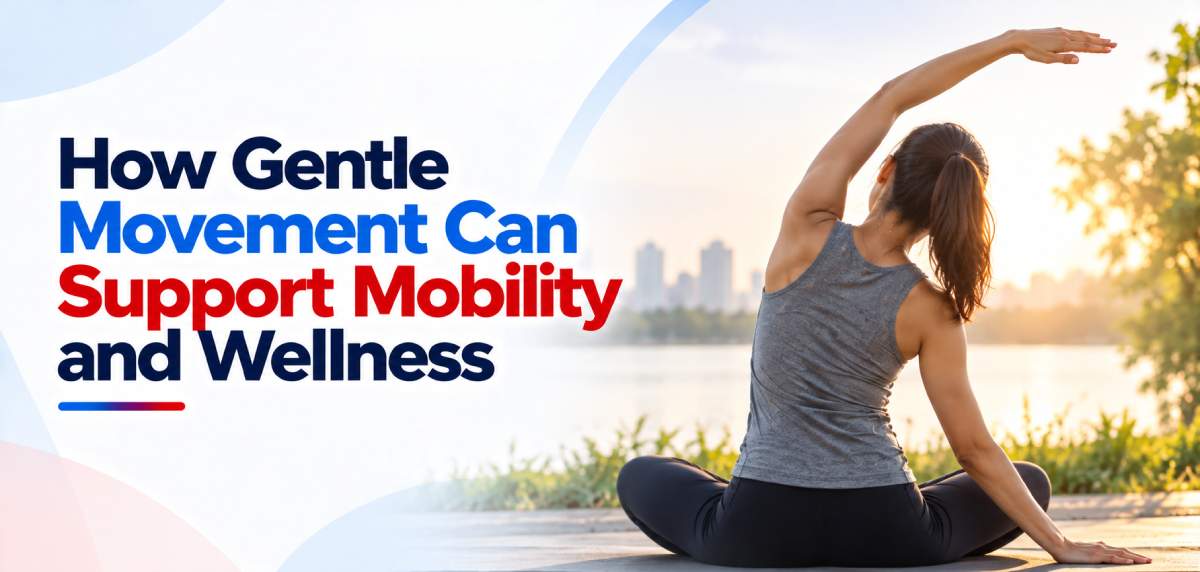
Some examples of such movements are slow shoulder rolls, twists while sitting, rotating of ankles, and mind-body exercises that consist of light stretching combined with deep breathing. They can be practised in any place – at your workplace, during breaks or while waiting for the compilation of code. The aim is not to get sweaty but to restore mobility, release tension, and become aware of the body’s needs. Gentle movements pay attention to the mind-body connection, which encourages the practitioner to feel any tightness, imbalance, and uncomfortable spots in the body that would remain unnoticed in other exercises.
Why Gentle Movement Matters for Mobility
Mobility is not just being flexible; it’s the capacity of your joints to move freely and effectively through the entire range of motion. Decreased mobility makes activities more difficult, increases injury risk, and negatively affects one’s quality of life. Tech specialists have to be highly mobile to stay healthy while performing daily duties that require concentration and limited movement. Mobility is something that many professionals do not even understand they lose until they start feeling pain or cannot do basic actions such as reaching something above their heads or looking back when driving.
Easy movement will aid in increasing mobility through joint lubrication via smooth movements that have no stress to the body, stretching muscles that tighten because of repeated postures, improving neuromuscular coordination and proprioception, and decreasing rigidity while improving circulation. In a study published in the journal Genetics and Molecular Research (2026), movement therapies were found to have a positive impact on musculoskeletal adaptations, balance, pain modulation, and psychological well-being of individuals. For tech workers, it is an additional benefit since they will not only feel better but also think clearly and work effectively. Good mobility will lead to good posture, which will aid in good breathing patterns and oxygen supply to the brain.
The Science Behind Mindful Motion
The advantages of gentle exercise go far beyond the physical. Moving mindfully engages the parasympathetic nervous system, known as the “rest and digest” system, which helps decrease stress hormone production, concentration and improves emotional regulation. This process can be particularly useful in stressful situations when the sympathetic nervous system, or the “fight or flight” system, is constantly engaged, causing high levels of cortisol production and muscle tension.
If you are moving consciously and mindfully, then you allow yourself a pause between the stimulus and response and help your brain and body reprogram. This is of particular importance in a stressful technology work environment where not only your technological skills but your psychological well-being matter. Gentle exercise promotes mindful movement, which in turn decreases anxiety, improves sleep quality and improves psychological state.
Furthermore, studies have shown that short and self-initiated periods of physical activity during sedentary activities reduce musculoskeletal discomfort and improve focus and attention. Essentially, engaging in a few moments of physical activity is not a distraction but a way of boosting one’s productivity. This is consistent with the current scientific evidence that regular physical activity enhances cognitive performance, memory retention, and creativity, which are fundamental skills for a job in technology.
Practical Gentle Movement Strategies for Tech Workers
Integrating gentle movement into your day doesn’t require a gym membership or a complete lifestyle overhaul. Small, consistent actions can yield significant results over time. Here are some practical strategies tailored for tech-savvy individuals who need solutions that fit seamlessly into demanding schedules.
Micro-Breaks That Make a Difference
Rather than leaving it until the end of the day to stretch, incorporate little stretches into your routine as you work. Have a timer on you that tells you when it’s time to move for about 30 to 45 minutes. Even just 60 to 90 seconds of purposeful stretching is enough to help re-centre your body and clear your mind. There are many productivity applications and browser extensions available that help automate this process for you.
Here’s a simple exercise that you could do at your desk. First, roll your shoulders forward and backwards five times, followed by tilting your head from side to side for 10 seconds. Raise your legs one at a time and point your toes in order to stretch your calves and hamstrings. Lastly, get out of your chair and reach upwards before folding over. The whole exercise takes under two minutes but will give you hours of relief from accumulated stress.
Desk-Friendly Mobility Drills
You don’t need special equipment to improve mobility. Many effective exercises can be done right in the workplace. For instance, seated spinal twists are effective in fighting against the forward hunch that affects many software developers and designers. Such movements focus on the thoracic spine, which is likely to be stiff and restricted due to the amount of time spent in a forward-hunched posture. As a result, it leads to pain in the neck and shoulders.
The process of doing a seated twist starts by sitting upright with both feet placed flat on the floor. Place your right hand on your left knee and your left hand behind your back. As you inhale, lengthen your spine. As you exhale, rotate your body to the left. Hold this position for 20–30 seconds while breathing deeply, then repeat the exercise on the opposite side. Another effective drill is thoracic extension over the back of a chair. It involves sitting at the edge of the chair with hands clasped behind the head and leaning backwards over the upper edge of the chair. This exercise should be held for three to five breaths in order to release the mid-back.
Movement Snacks Throughout the Day
Imagine physical activity in a similar way to nourishment – small, repeated “snacks” are usually much better than one big “meal.” It is much better to break down the day into smaller bits of physical activity, rather than performing it only once after you finish working. The idea is to go back to how our ancestors used to live, always being on the move without sudden bursts of activity and long breaks afterwards.
Some examples can be going up stairs instead of using elevators, walking while talking on the phone or even during video conferences, doing calf raises when your coffee is preparing, and doing stretching exercises for your wrists and fingers between coding sessions. You can also keep your resistance band near your desk for quick activation exercises or a standing desk converter.
How PainBegone Complements Gentle Movement
The company PainBegone understands that true health can only be attained through a balanced program involving not only professional intervention but also personal involvement. The services we offer aim to target the issues behind your pain, as opposed to addressing just the symptoms of the problem. Whether you suffer from chronic pain, you are recovering from injury, or you want to boost your performance levels, we can provide customised services that suit your specific lifestyle. We understand that every body is unique, and an approach that is effective for one person may be useless for another; hence our emphasis on individualised and continually assessed services.
Mindful movements make a wonderful addition to PainBegone’s services since they ensure that the work done in your treatment sessions does not go in vain. For example, if you have undergone manual therapy or corrective exercise prescription at our clinic, including gentle movement into your daily life will help you consolidate those gains and avoid any regression.
Personalized Guidance and Digital Support for Lasting Results
Our practitioners usually suggest gentle movement exercises, which may be specifically designed for individuals. They may consist of stretches for tight hip flexors, mobility exercises for people slouching behind their computer desks, or breathing techniques aimed at decreasing tension in the body. As a result of working with our practitioners and applying regular care, our clients are recovering quickly and becoming more active and healthy. Over the years, we have witnessed the positive changes in our clients’ lives and helped many people change their attitude towards themselves and their body through our approach.
In addition, with the help of PainBegone’s digital tools and resources, you will not have any trouble staying on top of your activities. With our guided videos and movement programs designed specifically for you, you can develop healthy and sustainable habits that can easily become a part of your technological life.
Building a Sustainable Movement Habit
However, for someone to enjoy the fruits of gentle movements in the future, he needs to be consistent rather than intense in his exercise. One can start by engaging in gentle movements for a few minutes every day and slowly increasing the period. The best thing is to do so together with activities that one is doing, such as checking emails or standing meetings. By doing this, one will be applying the habit stacking principle that uses already existing neural pathways to create habits instead of depending on motivation and willpower.
One should keep track of their progress in the activity through apps and journals in order to see the changes. For instance, one will be able to observe the positive changes in his body such as improved posture, energy level, and mental clarity. All that matters is not perfection but improvement, since even a little progress matters. One should celebrate any success along the way.
Final Thoughts
Living in such a dynamic era where the majority of your job requires sitting in front of the screen, slow and thoughtful movement will serve as a great remedy for your body and mind. You will not only improve mobility and decrease the feeling of discomfort but also contribute to the state of your well-being in general without interrupting the working process. You will definitely appreciate your investment in your physical health in the future when it helps you maintain your career.
At PainBegone, we strive to provide you with the means to achieve the greatest results regarding your health and physical performance in general. We will help you cope with your pain and find effective ways of optimising your performance in the gym. At PainBegone, you will find the necessary information and help to improve your well-being.
Start today. Take a deep breath. Roll your shoulders. Stand up and stretch. Your body—and your mind—will thank you. The journey to better mobility and wellness begins with a single movement, and that movement can start right now, wherever you are.