19
Nov
What Does Holistic Wellness Really Mean?
This is looking after yourself on every level – mind, body, and soul – rather than waiting for things to happen. It involves seeing the links between physical health, mental health, emotions, your social connections, work and sleep, environment, and even why you are here.
For those of you who are at least a little tech-savvy, this concept might seem familiar. There is all sorts of information on how many steps you take, your sleep score, exercise, calories, productivity – and yet there are issues of stress, pain, exhaustion, or burnout. Holistic health isn’t about going against technology or conventional approaches to wellness. Rather, it’s about a bigger-picture approach to what you need.
It’s More Than Just a Disease-Free Life
The majority of us consider health to be the absence of disease. Holistic health and wellness disputes that minimal outlook. The initial definition of health and wellness by the World Health Organisation (WHO) as a state of good health and wellness was: “a state of full bodily, mental, and social well-being.”
The point is that you can be medicine-fine but still numb, tired, anxious, depressed, and absent or be in pain all of the time. You may be working on your deadlines, training for races, and never slowing down, but you don’t feel well. Holistic wellness takes a different approach: not “What is wrong?” but “What is getting in the way of feeling well, moving well, living well?”
The word holistic comes from the word whole. Rather than separating your body, mind, relationships, habits, and environment into different categories, a holistic approach looks at how all these aspects connect and influence one another. (Disrupted sleep increases pain, chronic pain affects mood, stress impacts digestion, focus, and recovery, and social support increases accountability.)
The Core Dimensions of Wellness
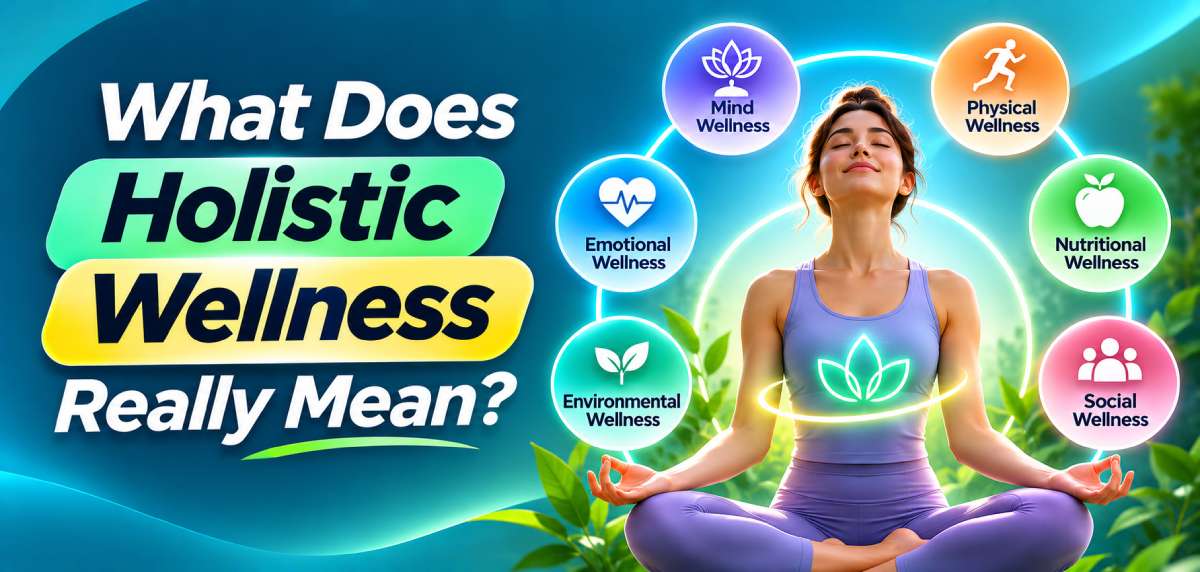
It generally encompasses physical health, mental health, emotional health, social health, spiritual health, and occupational health. The labels differ, but the idea is always similar: these areas are each other’s foundation.
Physical wellness is physical activity, eating healthy foods, quality sleep, flexibility/movement, strength, and how your body responds to pain or injury. Mental wellness is concentration, mental toughness, the ability to maintain a balanced mind, and the ability to positively regulate stress. Emotional wellness is your ability to identify, communicate, and process emotions.
Your social wellness indicator is your connections with other people, and your sense of belonging. For some, spiritual wellness isn’t spiritual at all; it’s a sense of purpose, the values you hold, your spontaneity or natural affinity for the earth, your time for self-reflection, and your ability to find connection to something beyond yourself.
Over time, neglect in one area is often seen elsewhere. A busy workday might lead to less sleep, which leads to more stress and pain, which may then impair exercise, mood and relationships. Wellness solutions that take a holistic approach are a way to break that cycle by treating patterns, not just their symptoms.
Why Holistic Wellness Is Important Today
Today’s health system promotes treatment instead of true health. You might see one doctor for your back, one for your stress, one for your nutrition, and one for your sleep – nobody looks at the big picture. Holistic wellness promotes a comprehensive approach to health: lifestyle, contributors, prevention, personalised care and just the right care from a doctor.
Specific chronic pain, tension, stress, fatigue and mobility issues. No matter how much pain we have, our pain is always being impacted by our sleep, movement patterns, stress, work/posture, workload and recovery, and our emotional health. Managing just the painful area may provide some temporary relief, but taking a whole-person perspective can shed light on what’s fueling the cycle of pain.
Remember, holistic wellness isn’t about being perfect. You won’t be perfect at eating, at your morning routine, or stress-free all the time. The idea is to do the best you can and develop habits that are sustainable and help you live how you want to live.
What Holistic Wellness Is Not
Some may use holistic wellness as a way to pit themselves against physicians and medicines or science-centred care. When done thoughtfully, holistic health cannot replace conventional medicine, but it can work alongside it. Integrative health involves conventional medicine plus evidence-based interventions like diet and nutrition, meditation and stress-reduction, movement and physical therapy.
Or it isn’t just a hollow assurance to get things back on the right track “at present.” It is necessary to visit a physician only when the signs are more complex, you’ve been wounded, contaminated, or you have sudden or extreme pain. Whole health is best when it enables you to think more widely and grow in control of your health, and respect doctors.
Lastly, you can’t pour a one-size-fits-all protocol into the basket of total well-being. Remedies for a high-achieving athlete could possibly be an excessive amount for an individual working from home and hunching over a computer. An individual with poor sleep, a mother or father to some unruly kids, and someone recovering from an injury all want very different help.
Getting Started the Easy Way
Observe, don’t overwhelm. Over the next week, observe your energy, pain/tension, sleep, stress, movement, diet, screen time, and social time. What patterns are you noticing? Do you notice that you carry a lot of tension in your shoulders after a long period of typing? Do you notice that your pain is worse if your sleep quality was poor?
Pick one small adjustment that can touch several different areas of health. A daily walk: influences your movement, blood flow and low-level inflammation; offers you some time to yourself; and keeps you off the couch and away from a screen. Eating and sleeping on a schedule: benefits your sleep, your mood and your body. Moving your body: without strain or intensity, using mild mobility practices (like what you’ll find in this program), relaxes your body and quiets your mind.
Simple is best: gentle, small daily movements, food, sleep, stress management, connection and rest, and the most appropriate for you. It’s not necessarily the big, dramatic change that makes the biggest difference. It’s the daily, small steps.
Where PainBeGone is Positioned
That’s where PainBeGone comes in. Instead of treating pain as an isolated condition, it encourages mindful, complete treatment that investigates the causes of the pain and encourages long-lasting restoration and vitality.
Its practitioners have backgrounds in various but complementary fields such as acupuncture, remedial and sports massage, physiotherapy, traditional Chinese medicine, shiatsu, dry needling, cupping, osteopathy, pregnancy massage, and acupressure. With such a wide scope of experience, you get a more personal treatment that can be adapted to meet your requirements.
Whether you suffer from aches and pains or increased stress, PainBeGone wants to be your partner for recovering and restoring your health. Our practitioners start their first interaction with you with an initial consultation and then customise the treatment for your particular situation, embracing the holistic approach of viewing the individual, rather than the problem.
PainBeGone can also assist you with a number of other health goals. Sports and remedial massage can assist with musculoskeletal pain, recovery, flexibility and prevention of injury with assessments, trigger-point therapy, deep-tissue work, myofascial stretch and cupping.
A Personalized Path to Whole-Body Wellness
Physiotherapy services encompass everything from pain and movement to injury prevention and recovery. PainBeGone’s Physiotherapy for Athletes provides sports-specific physiotherapy to enhance your sporting performance, as well as your preparation and recovery from injury.
If you are looking for more mind-body focused care, then you may wish to consider some of PainBeGone’s Qi Gong and holistic wellness services, which incorporate movement, breath, natural health solutions, health coaching, energy balancing work, sound and vibration. These services can assist with pain and mobility, energy, stress, sleep, and more.
The value is not in selecting one “best” treatment. It is in working to devise a plan that is tailored to your body, your life, and your goals. If you’re someone with desk-sitting neck and shoulder tension, you may benefit from hands-on treatment and advice, movement education, and stress management techniques. If you’re an athlete, you may need massage and sports physiotherapy for recovery.
Making Wellness Sustainable
Holistic wellness is effective when it has a comprehensive approach and becomes a routine. Rather than allowing fatigue, burnout, and ultimately pain to be your motivator, you can create regular stop points in your week. Are you moving enough, getting enough sleep, resting, engaging with others, and creating space for things that make your life full?
Technology can help with this without adding additional pressure. Wearables and apps should be used for feedback, not judgment. Look at your sleep score and think about what you did the previous day differently. Look at your recovery scores and tailor your training and/or rest accordingly. Finally, if your stress levels are high, do a grounding exercise rather than piling on more demands.
Thinking more holistically also allows you to be kinder when things don’t go perfectly. Missing your workout, having a flare-up of pain, or a stressful week does not mean you have failed. It means that your body and life are trying to tell you something. The following step is to modify the plan, get the support you need when necessary, and keep working on habits that make you feel more capable.
Conclusion
This is what holistic health is really all about – not rejecting modern medicine or seeking perfection in your health and wellbeing. It’s about looking at yourself as a whole, integrated entity: your body, brain, mood, relationships, purpose, environment and the things you do every day. Doing this helps you to avoid illness and keep your health optimised.
When pain, stress, tension and fatigue have become your normal, there is a whole person approach that will allow you to go beyond symptom treatment. PainBeGone provides you with individualised holistic care that includes the use of Qi Gong, natural health coaching, remedial & sports massage, physiotherapy, acupuncture and many other modalities aimed at improving your overall health and reducing pain. By learning to treat yourself well and not just your pain and fatigue, you can travel down the most empowering road to a better you.