How Stress and Tension Shape the Way You Feel Pain
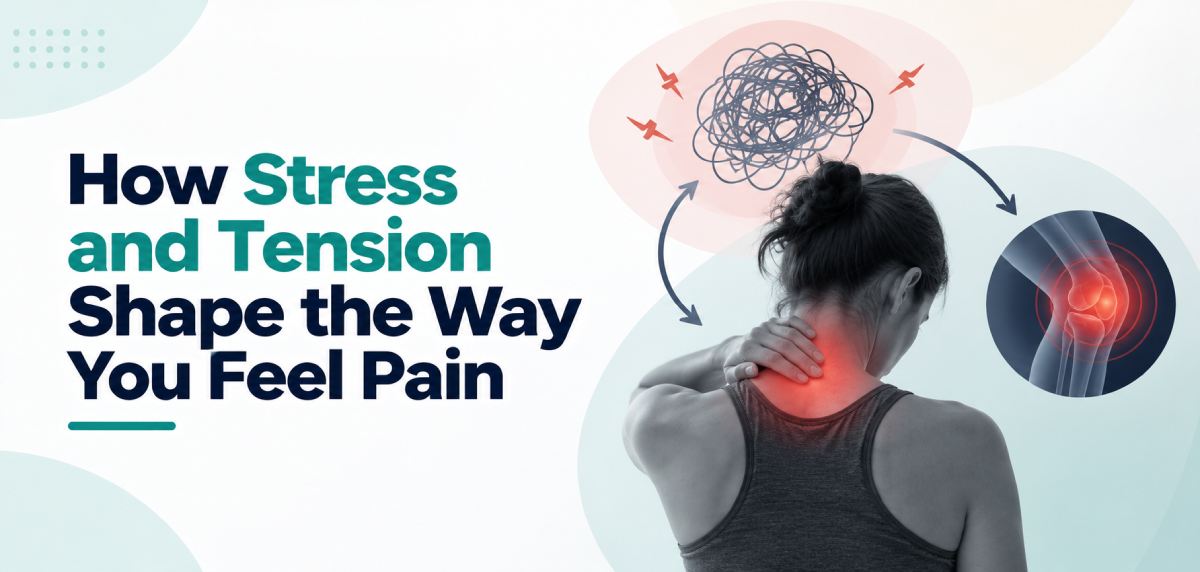
Stress and tension don’t only reside in your mind; they have a significant impact on how your nervous system perceives pain and can often transform it into something more intense than what you may be experiencing. In the age of technology, being able to relate to how stress and pain connect becomes your way of taking control not only over your stress but your physical pain as well. It’s not a linear relationship, but rather a complex feedback loop, whereby stress and pain feed off each other.
The Brain–Body Loop: Why Stress Makes Pain Feel Worse
Communication between your brain and your body happens constantly, and stress is a big part of this communication process. The moment you find yourself stressed out because of something, whether it is a deadline for some product release, having too many emails to read and respond to, or even stress resulting from your posture while coding for hours on end, your body becomes instantly ready for action. This means the release of a whole bunch of chemicals like cortisol and adrenaline, preparing your body to react and making your senses more alert. As a side effect of this process, pain is minimised (it is called stress-induced analgesia).
But there is a twist. If you have been exposed to prolonged stressful events, your brain will react by activating your stress response system, including HPA and the sympathetic nervous system. This triggers the phenomenon known as stress-induced hyperalgesia, where the pain threshold is lowered, and sensations become magnified. It is not “all in your head.” Research based on neuroimaging reveals that the areas of your brain responsible for emotion regulation and pain modulation, including the amygdala and prefrontal cortex, become rewired due to stress exposure. Therefore, with time, your brain makes your nervous system more sensitive to even minimal changes, such as tightness in muscles caused by long hours spent working at the desk.
The Endocannabinoid System: Your Body’s Built-In Pain Modulator
This mechanism, which is not commonly known, is essential for the regulation of mood, appetite, sleep, and most importantly, perception of pain. In case of acute stress, the organism releases the endocannabinoids such as anandamide and 2-arachidonoylglycerol in order to mitigate the effects of the stress response. Unfortunately, under chronic stress, the production of natural pain inhibitors, i.e., endocannabinoids, gets depleted, and cannabinoid receptors, mainly CB1 receptors, are downregulated. In turn, the nervous system becomes less efficient at inhibiting the pain signal propagation. Scientific research proves that restoration of endocannabinoid tone, by means of various treatment options, including cannabinoid therapies, in certain cases, can solve the issue of stress-induced hyperalgesia.
Muscle Tension: The Physical Bridge Between Stress and Pain
Probably one of the most immediate ways in which stress manifests itself in terms of physical discomfort is through muscle tension. If you’re feeling stressed, your body automatically contracts—mostly around your neck, shoulders, and lower back area. While this is not a bad feature, but rather an evolutionary adaptation to dealing with stress by literally running away from dangers, nowadays this is the response we have for constant Zoom sessions or coding until late at night.
Electromyographic (EMG) research confirms that negative emotions and psychological stress increase muscle activity in the upper trapezius and paraspinal regions, often leading to what feels like spasms or deep aches. For developers, designers, and data scientists who spend hours hunched over keyboards, this creates a vicious cycle: stress causes tension, tension causes pain, and pain fuels more stress. The result? A feedback loop that can evolve into chronic conditions like tension-type headaches or myofascial pain syndrome if left unaddressed.
These are simple but impactful mechanisms. Holding static postures, such as leaning the neck forward to view a computer screen, raising the shoulders while typing, or keeping the hips flexed for hours, causes continuous low-level muscle contractions. In turn, this leads to decreased blood supply to the affected areas, causing the accumulation of metabolic waste such as lactic acid. Additionally, inflammatory cytokines sensitise the nerves in the muscles, which makes them more sensitive to touch and movement. At the same time, the central nervous system, which is already hyperstimulated by the presence of stress hormones, perceives the signals received as more threatening compared to those in a relaxed state.
The Role of Attention and Catastrophizing
Besides the biological process, there’s also a psychological one that affects the way stress impacts pain perception. Under stress, you’re hypersensitive. You become hyper-vigilant to threats, including sensations coming from your own body. Something as simple as a slight twinge in your wrist may be completely unnoticed on a weekend when you’re not doing anything; however, when you’re about to compete in an important race, it takes centre stage and becomes extremely intense.
The phenomenon is further reinforced by a cognitive bias called catastrophisation—the tendency to view pain as a sign of serious injury and inevitable deterioration. Catastrophizers demonstrate higher neural activity associated with processing pain and lower engagement of pain inhibition mechanisms of the body. Such thinking could unwittingly exacerbate physical conditions in a technological environment that values perfectionism and overwork. However, the awareness of the phenomenon can help change the trend.
Digital interventions in mental health are a new generation of promising solutions to help break this vicious cycle. Evidence from systematic review papers of over 1,200 randomised controlled trials reveals that mobile applications and internet-based cognitive behavioural therapy, mindfulness, and stress coping interventions can moderate such issues as stress, anxiety, and pain and improve psychological well-being. In particular, employees who are used to interacting with digital technology can easily incorporate such methods into their routine life.
Why Tech Workers Are Especially Vulnerable
The contemporary work environment in technology firms can be said to be designed to increase stress levels. Working in an open workspace (virtual or physical), having to switch contexts all the time, unclear deadlines, and the always-connected nature of communication channels like Slack and email contribute to increased sympathetic stimulation. Other ergonomically harmful factors include improper workstations, interference with sleep due to blue light, and inactivity.
Studies involving computer users have demonstrated that there are relatively high incidences of musculoskeletal injuries, especially in areas such as the neck, shoulders, upper back, and wrists.A randomised controlled study found that office workers who received ergonomic training and improved workstations experienced less pain in all these areas. Another meta-analysis reported that multi-component interventions—combining ergonomic modifications with physical activity—achieved clinically meaningful pain reductions, with neck pain dropping by 38% and hand/wrist pain by 37% in some studies.
Furthermore, many people in the tech industry are very analytical and tend to consider stress-induced pain as something “that comes with the job.” However, this approach does not mean the problem will disappear; on the contrary, it can solidify the neural connection between stress and pain. The critical thinking skills used to solve complex problems in the tech industry can also help you understand and manage your own physiology.
Breaking the Cycle: Practical Strategies for the Digital Age
The good news is that the stress–pain connection is modifiable. Because biological and psychological factors shape pain perception, targeting either or both can provide significant relief.
Interruption of the physiological response to stress should be the first thing to do. Mindfulness interventions, even brief ones, from 2 to 5 minutes of focused breathing during intervals between meetings can decrease the levels of cortisol and ease muscle tension. Wearable devices with heart rate variability monitoring provide biofeedback and allow one to recognise the signs that one’s nervous system shifts into overdrive even before pain occurs. There is evidence of the positive impact of digital interventions with structured mindfulness or cognitive behavioural interventions on pain and stress management.
Another thing to consider is muscle tension. Taking regular breaks during the day, standing up and stretching or walking for at least a few minutes every hour can help avoid static loading of one’s back and shoulders. Even factors such as monitor height, chair support, and keyboard position can significantly affect ergonomics. Research demonstrates that providing forearm support and training on ergonomics can help to avoid musculoskeletal disorders of the upper body and accompanying pain.
Professional Care That Resets Both Muscle and Mind
Those already suffering from this persistent pain will benefit from physical therapy, which will reset their muscle and nerve patterns. This is where professional help comes in handy. We at PainBegone have experience working with technologists with the same problems. Our treatment combines remedial massage, myotherapy, and acupuncture for deep tissue release and calming of the nervous system that triggers these pain sensations. We understand that one treatment does not suit everyone – the tension in the shoulders of software developers differs from that of project managers.
We also integrate education into every session. Knowing the reason behind your
increased pain when things get hectic helps ease anxiety and avoid catastrophization, and hence lessen the perception of pain. Our patients have noted that aside from experiencing reduced pain levels, they experience improved concentration and resilience amidst pressure because their body isn’t in pain anymore and therefore gives their brains more capacity to think clearly. Our therapists are up-to-date with the most recent studies regarding stress and pain, including new findings about the endocannabinoid system and neuroplasticity.
The Bigger Picture: Pain as a Signal, Not a Sentence
What’s fascinating about rethinking pain is viewing it not as dysfunction, but as a complex communication system. Pain that becomes exaggerated by stress is an alert to you: “There is something wrong with your environment or the activities you are undertaking.” Choosing to ignore this message will never make you more resilient, just more vulnerable to problems later.
To those tech-savvy people who love to optimise processes, consider that your body is the world’s best full-stack platform. Techniques for managing stress, ergonomic engineering, better sleep hygiene, and bodywork are not frivolous indulgences—you have to update your platform as part of your process optimisation, much like refactoring code and scaling infrastructure before launching a big project.
The scientific literature is clear about the fact that chronic stress affects pain processing on multiple levels, from periphery to central processing systems. But it is equally clear that those changes can be reversed. Ergonomic interventions can alleviate pain for 30–40%. Mindfulness and cognitive behavioural therapies help to varying degrees. Manual therapy can provide temporary relief and contribute to the stabilisation of the nervous system. What’s the most efficient way? Combine all three.
Final Thoughts
Pain and tension are not only present together; they have an effect on each other. Pain is intensified through the release of hormones, muscle guarding, an altered endocannabinoid system, and changes in the way our brains process pain signals caused by stress. This makes stress management a proper pain relief measure.
If you live in Brisbane and are ready to get away from quick solutions to your problems, at PainBegone we offer you scientifically based, individual treatment suitable for today’s tech industry worker. We know your unique physical needs in the field and treat both the symptoms and their root causes. Many developers, designers, product managers, and data scientists have managed to overcome pain and stress thanks to our treatments.
Calming down your nervous system and relaxing muscles can help not only alleviate pain but also stop it altogether. And in your line of business, having mental clarity and physical stamina is key. It’s a strategic advantage.